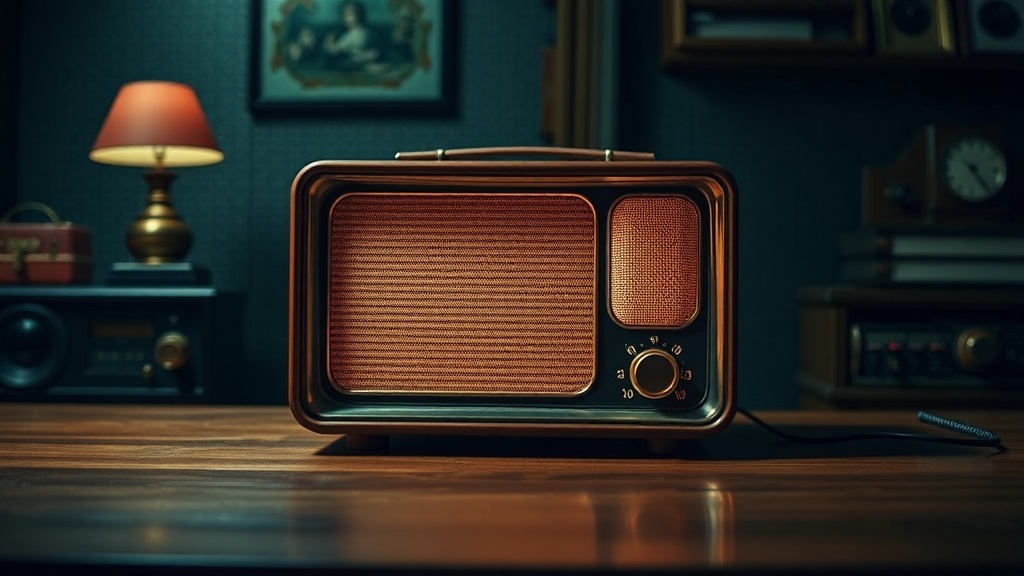
Beyond the Wood Box: Why Early Plaskon Tabletop Sets Reshaped Radio Design

Imagine standing in a 1934 department store aisle. To your left are the massive, floor-standing consoles that look like mahogany church altars. To your right sits a small, gleaming ivory box that glows from within. This guide examines the rise of early plastic cabinets like Plaskon and Beetleware, explaining why these materials revolutionized industrial design and how modern collectors can identify authentic pre-war sets amidst a sea of later reproductions. Understanding the chemistry and the manufacturing hurdles of the 1930s is the only way to appreciate why a tiny plastic box often costs three times as much as a towering wood console.
The shift from wood to plastic wasn't just about saving money; it was about color. Wood limits you to brown, slightly darker brown, and maybe a black lacquer if you're feeling adventurous. Plaskon—a urea-formaldehyde resin—offered a palette of pastels and whites that wood simply couldn't touch. These sets weren't just tools for listening to the news; they were decorative accents meant to match the 'modern' kitchen or the bedroom vanity. It’s hard to overstate how radical a bright red radio looked in a world of walnut and oak (and let’s be honest, wood is heavy and hard to clean).
What makes Plaskon different from later injection-molded plastics?
Early plastics like Plaskon and Beetle were compression-molded. Manufacturers didn't just squirt liquid plastic into a mold like they do today. They took powdered resin, put it under immense pressure and heat, and basically 'baked' the cabinet into shape. This created a dense, heavy material with a quality that modern plastics lack. If you hold a 1938 FADA 115 (the famous 'Bullet' model), the weight alone tells you it’s something different. The texture is cool to the touch—almost like stone or ceramic—rather than the oily feel of 1950s polystyrene. This process was expensive and prone to failure, which is why these sets were marketed as premium items rather than budget alternatives.
Because the resins were expensive, manufacturers often used them sparingly. This led to the 'Skyscraper' designs of the early 1930s, where the cabinet was vertical and compact. Designers like Harold Van Doren took advantage of the material’s ability to hold sharp, crisp lines that would be impossible to carve in wood without hours of labor. The resulting aesthetic was pure Art Deco—stepped shoulders, vertical ribs, and geometric patterns that looked like they belonged in a Fritz Lang film. These sets represented the height of the Machine Age, turning a piece of electronics into a miniature architectural monument.
Why do early plastic radio cabinets often have hairline cracks?
Heat is the enemy of urea resins. These radios used vacuum tubes that got incredibly hot—hot enough to burn your skin if you touched the glass. Because the plastic cabinets were compression-molded, they were under internal stress from the day they left the factory. When the heat from the tubes caused the chassis to expand, it pushed against the plastic. Over eighty years, that cycle of heating and cooling creates the 'shrinkage' cracks we see today. You’ll often find these radiating from the screw holes on the bottom or near the power tube at the back. It’s not necessarily a sign of abuse; it’s a sign of physics. Many collectors actually prefer a few minor 'checks' because they prove the cabinet is original and hasn't been replaced with a modern resin cast.
On top of the heat issues, these materials were brittle. Unlike Bakelite, which is reinforced with wood flour or other fillers, Plaskon was designed for its aesthetic clarity. This made it much more prone to shattering if dropped. If you're looking at a set with no cracks at all, you should look closer at the edges. A genuine pre-war set will have slight imperfections in the molding—tiny lines where the powder didn't quite flow perfectly. If the cabinet looks 'too perfect' and feels light, it might be a modern reproduction. You can find more detailed identification tips at AntiqueRadio.org, which is a fantastic resource for learning the physical characteristics of early sets.
Where can you find reliable values for 1930s tabletop sets?
Valuing these radios requires looking past the brand name to the material. A Philco wood tabletop might sell for fifty dollars at a local flea market, but a Plaskon version of the same chassis can fetch three hundred. Collectors should check resources like RadioMuseum.org to confirm if a specific model was originally offered in Plaskon. Don't rely solely on eBay 'sold' listings (which are often skewed by one-off bidding wars). Professional auction houses that specialize in 20th-century design often provide a more accurate reflection of what serious collectors are willing to pay for mint-condition sets. The value is almost entirely in the cabinet; a working radio with a smashed Plaskon case is worth very little, while a dead radio with a perfect ivory case is a gold mine.
One of the best tests for a genuine Plaskon cabinet is the flashlight test. If you take a bright LED light and hold it inside the cabinet, a real 1930s urea-resin set will often glow with a soft, milky translucency. Later painted Bakelite sets—which were often used to mimic the look of Plaskon—will remain completely opaque. This translucency is what gives these radios their 'inner life' when the dial lamp is lit. It’s a warm, organic glow that plastic just isn't supposed to have. Beyond the visual test, the smell is a giveaway. If you rub the plastic briskly with your thumb to heat it up, Plaskon often has a faint, medicinal smell that is distinct from the 'old basement' scent of Bakelite.
The rarity of these sets continues to climb because so many were lost to the brittle nature of the material. In the 1940s and 50s, when these radios were just 'old junk,' they were frequently tossed out because a single drop meant a shattered cabinet. Today, finding an Air King 52 or a FADA 'Bullet' in its original, unpainted Plaskon housing is like finding a piece of industrial history. These sets aren't just for listening to AM stations; they are sculptures that captured the optimism of a generation that believed plastic would save the world. Next time you see a dusty, ivory-colored box sitting in the corner of an antique mall, don’t just walk past it. Take a look at the edges for those tell-tale compression lines. Look for the way the light catches the surface—that soft, almost porcelain sheen. These early experiments were the bridge between the heavy Victorian past and our lightweight future. They represent a moment when we decided that even our most functional objects should be beautiful.